Previous page | ToC | Next page
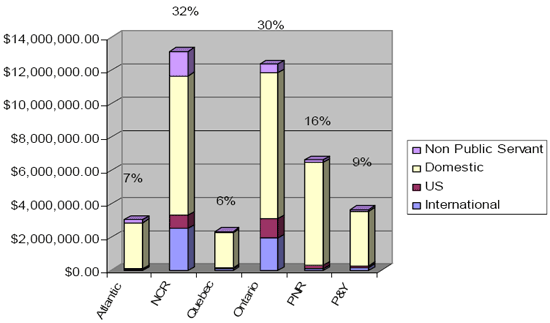
The Department of Environment Canada (EC) depends on travel to facilitate the operations of its various services. EC spent close to $41.1 million in travel expenses during the period under review. These expenses account for 5% of the total expenses of the Operation and Administration Vote. Of this, $31.3 million were spent on domestic travel, $4.9 million on foreign travel, $2.3 million on travel in the United States and $2.5 million on travel for non public servant such as consultants required to travel as part of contract work. A regional breakdown of travel expenses by type is illustrated in Figure 1.
Figure 1 - Regional Breakdown by Type of Travel
Over the last three years, the value of the travel expenses has increased by approximately 21%. However, the hosting of 11th Session of the Conference of the Parties in the Fall of 2005 accounts for 7% of this increase. On the other hand, the analysis also highlighted that the expenditures on international travelling have decreased by 19%. A breakdown of the last three years travel expenses by type is illustrated in Figure 2.
Figure 2 - Travel Expenses for Last Three Years by Type

Using the data contained in the Travel Expert System (TES), various analyses were conducted to identify any anomalies or unusual travel patterns such as multiple attendances to the same conference, travel to exotic locations, and number of trips. Approximately 35,000 trips were administered through TES in fiscal year 2005-06. It is important to note that while most regions have been using TES to administer their travel claims for a number of years, the Atlantic Region only started to use TES in September of 2005. Consequently, the following analysis does not include the trips processed prior to September for the Atlantic Region. In addition, field workers who do not have access to TES and non-public servants are required to process their claims manually. Therefore, these are not included in this analysis as well. Ninety percent of the trips were in Canada, 4% were to foreign countries and 3% to the United States.
A variety of options for accommodation are available for travel. Generally these include hotels, motels, corporate residences, apartments, private non-commercial accommodation, and government and institutional accommodation. Although travelers generally stay in commercial accommodation, private non-commercial accommodation is encouraged. The analysis demonstrated that private accommodation was claimed in 1,915 trips. A total of $218,895.87 were reimbursed representing approximately 4,378 nights. Assuming that the average rate for commercial accommodation is $100.00 a night, the Department saved approximately $218,904.00 in accommodation fees over the year.
The data analysis did not find any anomalies pertaining to multiple attendances to conferences in foreign countries. This might be directly attributed to the fact that international trips and conference attendance are to be submitted to senior management for pre-approval on a quarterly basis. This requirement allows senior management to better plan and control attendance to conferences and international trips.
The audit included an examination of the different elements of a sound control framework. The following four areas were identified as being crucial:
Based on the Treasury Board Travel Directive, the Departmental Policy should be consistent with Treasury Board policy on travel. Our review indicated that Finance and Corporate Branch released a Departmental Travel Policy in 2002. The departmental policy states that '...it is Environment Canada's policy to follow the Treasury Board Travel Directive for all government business travels'. Therefore, the department is complying with TB policy. The departmental policy also identifies the Travel Expert System as the tool to be used to manage and administer business travel in the department. The system includes a number of control points in line with the policy.
Environment Canada's accountability framework for the administration of the travel program is as follow:
The Departmental Travel Coordinator is responsible for ongoing management of the travel program in the Department which includes: liaising with Travel AcXess Voyage, the Government Travel Service Provider, on department wide issues as required; monitoring and reporting on the travel program, ensuring Department-wide compliance to the travel policy; and maintaining good communications with the Regional Travel Coordinators.
The Regional Travel Coordinators are responsible for travel directive interpretations, monitoring and reporting on travel in the Region and performing a challenge function.
The National Travel Expert System Administrator along with counterparts in each of the regions are responsible to clarify questions pertaining to the use of the TES.
Travellers are responsible to prepare and submit the travel authority and advance form and the reimbursement of the travel expense claim with necessary supporting documents.
The managers are responsible to ensure that travel arrangements and the reimbursement of the travel expense claims are consistent with the provision of the Treasury Board Travel Directive.
The Financial Management Advisors are responsible to ensure that the Frequent Travel Authority are duly completed.
As previously mentioned, Environment Canada uses the Travel Expert System (TES) to compile travel-related data. This Web application allows travelers to electronically prepare their request for travel authority and advance as well as their reimbursement of travel expenses. TES allows the electronic exercising of the financial authorities set out in Sections 32, 33 and 34 of the Financial Administration Act. Although EC did not comply with the Treasury Board's central policies on electronic or digital signature at the time of the audit, starting in fiscal year 2007-2008, the requirement for a wet signature of Section 34 will be reinstated.
The responsibility for the system of account verification and related financial controls rests with the officers who are delegated payment authority pursuant to FAA Section 33. The officer must provide assurance of the adequacy of the Section 34 account verification.
All regional finance offices review one hundred percent of travel expense claims pursuant to Section 33 of the FAA. The results of the interviews and the mapping of the travel process in each region revealed that there were no consistent standards in place for monitoring of travel expenditures at the time of the audit. For example:
The Financial Policy and Operations Division has undertaken a project that will ensure that consistent standards for the monitory and auditing of travel expense claims are implemented across all the accounting offices within the department. The time lines for this project are such that completion date for the implementation of these standards is set for the end of June 2007. These standards will also include a series of general accepted error type codes that will be used to identify the types of errors encountered when processing travel expense claims. The information on the error codes will be collected by the Financial Policy and Operations Division and used to update the departmental travel directive and training material.
An automated interface between TES and Merlin that financially commits all travel authorities was implemented as of January 31, 2007. The commitment of these types of expenditures will strengthen Finance's ability to monitor travel expense claims and ensure standards are consistently applied across all our accounting offices. They are also looking at implementing, at the beginning of fiscal year 2007-08, travel expenditure monitoring reports in support of the application of consistent standards.
Based on these observations, we concluded that monitoring practices and controls are either already in place or will be in place in the very near future. No formal recommendation will be issued at this time; however, Audit and Evaluation Branch will conduct a follow-up to ensure that all elements of the new travel process are implemented as expected.
Currently each region has a web page on its intranet site that provide travel information and advice to travellers. However, it was noted that the documentation or links provided on the web pages were inconsistent across the regions. Each region makes reference to TBS Travel Directive and TES directives and some have added other relevant documentation. For instance, one region has developed a virtual training package for travellers. Another region has developed detailled procedures pertaining to the travel directive.
The Travel Expert System contains a number of links relevant to travel information. However, the documentation associated with these links is somewhat outdated. For example, in 2005 the use of the Blanket Travel Authority was replaced with a new form called the Frequent Travel Authority (FTA). This change has not been reflected in the current Departmental Travel Policy and TES Training Guide.
Based on the interviews with finance staff, we found that the level of training provided to travellers regarding travel and approval of Section 34 of the FAA was inconsistent across the regions. As previously mentioned, one region provides virtual training via the intranet site but most regions provide informal training to the Administrative assistants who in turn have to train new employees. The training usually focusses more on the Travel Expert System application than the Travel Directive.
An "EC Finance Web Site Advisory Group" was created In June of 2005 with the objective of making recommendations to the Finance community on the design, development and implementation of a single EC Finance website.
While the implementation of a unique departmental website did not take place due to difficulties in obtaining technical support for a new Web page editing tool, significant progress has been made in the realization of this objective. For example:
The Finance website unit within Financial Operations is currently involved in a departmental working group, lead by the Communications Branch, which is looking to standardize all the websites within the department.
The current Departmental Travel Policy and Travel Training Guide are currently being updated to reflect the new changes in the travel processes. The revised travel policy and training guide should be available to the departmental end-user community by mid May, 2007.
Travel should be authorized in advance to ensure that these expenses are incurred in accordance with the provision of TBS and departmental policies.
All business trips by employees must be formally authorized in advance. The managers are to use the electronic authorization feature available in the Travel Expert System to authorize individual travel authority. This electronic form contains information such as travel date and time, purpose, air and ground transportation, destination, estimated cost, etc, allowing the manager to approve the travel conditions and ensuring that the expenses are eligible for reimbursement.
The analysis of criteria related to the pre-authorization requirement (FAA Section 32) identified the following:
Furthermore, the analysis also demonstrated that pre-authorization was obtained after the start of the trip in 8% of the cases. All were pre-approved by an individual with proper delegated authority.
Several TAA were missing key information such as type of transportation (20%) and estimated cost for accommodation, flight or meal (6%). The default departure and return times were often not adjusted to reflect the actual time (15%). This, combined with the fact that the travel itinerary was often not provided, makes it difficult to assess what meals should be reimbursed on the day of departure and return. This last issue has since been resolved as the 'time' field in the travel itinerary in TES was made mandatory in December of 2006.
The new travel process will introduce a number of tools to help better manage the pre- authorization of travel claim. For example, Finance and Corporate Branch will issue a monthly report identifying claims that did not obtain proper authorization. This will help identify employees frequently not complying with the policy. Furthermore, managers with delegated travel authority, receive for their review, a listing of travel authorities on a monthly basis.
Treasury Board Policy allows for Blanket Travel Authorization (BTA) to be used when an employee's travel is frequent in nature. This allows employee to travel without having to seek pre-approval on a trip-by-trip basis. On April 3 of 2006, the Department replaced the use of the BTA with a Frequent Travel Authorization (FTA) form. Although this new form basically serves the same purpose, the criteria use to grant such pre-authorization are much more stringent. Only employees travelling at least 10 times during the year are eligible for an FTA. The form has to specify limits in terms of geographic location, timeframe, dollars, etc and has to be reviewed and approved annually.
In our review of the travel policy and practices relating to the administration of the Frequent Travel Authority we observed the following:
Due to the frequent travel of certain employees, we believe that a Frequent Travel Authority that restricts travel to particular territories and modes of transportation is an efficient and appropriate way to pre-authorize travel. However, it should be limited to frequent travellers.
Based on the new travel process, an FTA Summary report will be produced on a semi-annual basis. The report will include an analysis of the frequency of travel per FTA user as well as the average dollars spent per trip per FTA user.
We agree with the recommendation. The Financial Policy, Systems and Operations Division will be issuing a communiqué before April 20th, 2007 to inform the Travel Expert System user community that the use of the Frequent Travel Authority Code (FTA) is included on all travel authority records when applicable.
Special instructions will also be issued to all the Managers Financial Services and to the Managers of the Accounting Offices prior to March 31st, 2007 to ensure they inform their clients of the requirement to reference their FTA on the travel authority before renewing their FTA for the 2007-08 fiscal year.
Treasury Board Secretariat Policy on Account Verification states that (1) the responsibility for verifying individual accounts rests with the officer who has the authority to confirm and certify entitlements pursuant to Section 34 of the FAA, and (2) persons with this authority are responsible for the correctness of the payment requested and the account verification procedures performed.
To obtain a travel reimbursement, EC employees must prepare and forward a travel claim, along with all supporting documentation, including original receipts and an explanation for any travel practice that deviates from the travel policy, to their manager for approval. Once the manager has reviewed and approved the claim and signed for Section 34 of the FAA, the claim is forwarded to Finance for further processing and verification prior to issuing a payment.
The analysis of criteria related to key controls shows a compliance rate of 93% under Section 34 and 100% under Section 33. The errors under Section 34 related to unauthorized official approving the expense claim (wrong cost centre, expenditure period or nature).
The analysis also revealed that the level of due diligence applied by the officer who has the authority was inconsistent throughout the Department. The majority of the travel expense claims reviewed contained adequate supporting documentation to substantiate compliance with policies and reasonableness of expenditures claimed. That said, there were instances where information and/or supporting documentation necessary for proper Section 34 verification was missing or incomplete. This included travel itineraries (18%), and receipts to substantiate expenses (9%). There were also a few case cases where expenses claimed did not fall within the approved travel period (4%). These were normally expenses from a previous trip that had not been claimed. Furthermore, information pertaining to either the conference or the training attended was rarely provided making it difficult to assess meal entitlements.
In light of the Transformation of the Travel Process, finance staff is now required to exercise a pre-audit of all travel claims before the manager with Section 34 authority approves the claim. For example, the process looks at whether an authorized officer exercised Section 32, expenses were claimed in accordance with policy (meals, incidentals, and accommodations), meals allowance being claimed are within the departure and arrival times, meals are provided by the transportation carrier, government travel provider was used for reservation, etc. The pre-audit also ensures that all receipts to support travel expenditures are attached to the travel expenses claim. The implementation of this new procedure should ensure both the travellers and their managers comply with new departmental travel directives.
The audit found three cases where substantial cash advances were issued to one employee who was in turn responsible to reimburse per diem cost to non-employees invited to attend an EC conference. In one case, an international conference was organized and paid for through a travel claim. Management was informed that the procurement tool used was inappropriate and advised of the tool to be used in the future.
The testing of foreign travel expense claims revealed some cases with insufficient details to justify practices that deviated from the norm and consequently made it difficult to determine whether the expenses claimed were reasonable. For example, we found cases where the travellers extended their stay either before or after the conference. Most of them were appropriately documented and pre-authorized; however, there were instances (9) where expenses were continuing to be claimed with no supporting documentation to indicate that other official business was being conducted. We also found instances where the traveller claimed for meals that were included in the air flight; or the employee travelled using business class with no justification on file. Explanations for all of these cases were obtained from respective senior managers who were also informed of the need to ensure that sufficient and complete documentation is provided with the travel claim.
We agree with the recommendation. A communiqué from the Director General, Finance Directorate will be sent out by April 20th to the Travel Expert System end-user community and end-user support network informing them of the requirement to provide sufficient information documentation to support the entire travel period.
Furthermore, a process to capture multiple attendances at conferences, along with a mechanism to ensure that sufficient justification/explanation for non senior or support level is provided when travelling to international conferences, will be developed.
The Financial Policy, Systems and Operations Division will also be issuing special instructions to all the Accounting Offices by the end of April 2007 requesting that the pre-audit function include ensuring that sufficient information/documentation to support the entire travel period is included with each travel claim. Failure to comply with this requirement may result in the travel claim being returned to the traveller with a request that he/she provides the necessary documentation.
According to Treasury Board Proactive Disclosure Policy, as of December 2003, EC must publish all travel expenses of the Minister, the Minister's Office and senior executives on its website.
There were 338 travel expense transactions posted on the website during the period under review, April 2005 to March 2006, for a total of $980,526.77.
To ensure that all travel claims had been disclosed, individuals subject to mandatory disclosure were identified and the list validated. All acting assignments in ADM positions and above were also reviewed. Travel transactions in TES and in MERLIN (Discoverer) were examined and compared.
Our tests showed that, in general, all travel claims were published on the website and that the information was accurate, with the following exceptions.
The examination of the travel claims showed that all travel claims were disclosed except for two. This represents less than 1 percent error rate. An interview and further analysis with the financial officer responsible for providing the detailed trip information to Financial Policy and Operations indicated that the reasons for the omissions were administrative in nature. In one case the claim was missed because it was a transaction paid manually in MERLIN, and was not coded against the budget of the individual having to disclose. This error should not reoccur, as all entries in MERLIN are now scanned to ensure there is no travel activity for individuals requiring disclosure. In the second case, the error was caused by an incorrect entry in the starting date for the period of acting in the proactive disclosure system.
Employees in an acting assignment and travelling on behalf of an individual subject to proactive disclosure must also disclose their travel expenses. Currently, the disclosure coordinators are not systematically informed of all acting assignments. In order to minimize the amount or research required when preparing for the quarterly report, the individual who manages the specimen signature cards in NCR and in Downsview should systematically inform the appropriate disclosure coordinator of all upcoming acting assignments.
There were thirty-eight individuals travelling during the period under review, out of a potential of forty-seven; this includes long term acting appointments. There were no cases of individuals travelling in the capacity of the acting position during a short term acting period (two weeks or less).
The process for the disclosure of travel information is very onerous for the financial analyst who is required to provide accurate and updated data to Financial Policy and Operations. (Please refer to attached flowchart in Annex 1 - Process for the Disclosure of Travel) The final amount for airfare is always different from the prepaid amount entered in TES. Usually the final amount is greater, because of additional administrative charges related to Travel AcXess Voyage or/and charges related to modified travel plans. When a credit is required, it is often initiated by the airlines through AMEX in the months that follow. Accounting operations must therefore manually check hundreds of lines of transactions to find adjustments for the selected individuals.
The audit did not find any cases where the amount was incorrectly stated on the website. Credits or debits were all accounted for and documented in a separate filing system for all the proactive disclosure claims.
EC's National Capital Region, responsible for the disclosure of the vast majority of the individuals in the department, has recently developed a worksheet to track all changes to travel data since the last quarter. This should result in improved efficiency when dealing with enquiries.
According to the TB Guidance document for the proactive disclosure of travel and hospitality expenses, the date posted must cover the full period between departure and return of the trip.
The audit has revealed that in 13 cases out of 338, or 3.8%, the period disclosed was shorter than the actual period of the trip. Eight of these cases were related to the Climate Change Conference (CoP 11).
The tendency was to publish the date of the conference rather than the dates travelled. A closer look at the cases showed that the travellers claimed expenses for a greater period than disclosed. An interview with Accounting Operations indicated that the change to the dates is made at the request of the travellers' offices. A better control of the process should be initiated in order to enhance the compliance to the policy.
We agree with the recommendation. The Director General, Finance Directorate will ensure that those persons subject to mandatory disclosure are obligated to disclose the entire period of travel where expenses where incurred and ensure that the dates disclosed reflect the entire period prior to the next disclosure period, i.e. June 1st, 2007.
Financial Policy, Systems and Operations Division will also issue a memorandum to all the Accounting Offices and the support staff of those persons subject to mandatory disclosure to remind them of the requirement to disclose the entire period of travel expense as well as to ensure the dates disclosed reflect the entire period.
