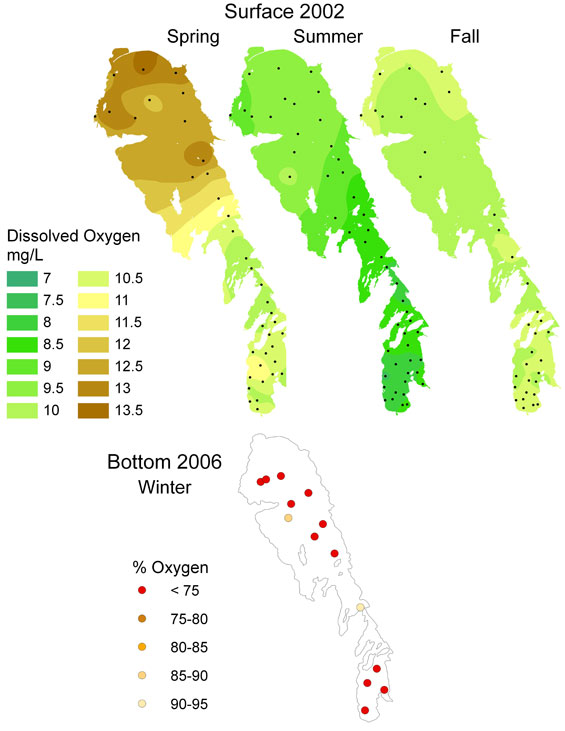
Seasonal dissolved oxygen concentrations in Lake Winnipeg surface (2002) and bottom (2006) waters
Data source: Environment Canada
(click to view larger image)
| Previous | Table of Contents | Next |
Water temperature affects the energy available for biological productivity and chemical processing in lakes, including the availability of dissolved oxygen for sustaining aquatic life. Water temperatures are typically higher in the smaller, shallow south basin and lower in the large, deeper north basin. Water in the north basin takes longer to warm in the spring than that in the south basin because of its large volume. The open water season, during which waters warm and light availability increases, driving biological productivity, is approximately 180 days in the south basin and about 14 days shorter in the north basin. Climate change has the potential to alter water temperatures and associated lake characteristics.
Summer water temperatures in the south basin from 1999 to 2007 were typically 2.0 to 3.0ºC higher than those in the north basin. The lowest was in 2004 (17.1ºC) and highest in 2007 (22.9ºC). Computer modelling based on air temperatures indicates that mean monthly water temperatures from 1999 to 2007 were not markedly cooler or warmer than any other decade since the mid-20th century. It is interesting to note that the water column of Lake Winnipeg is typically well mixed with bottom waters within 1.0 to 2.0ºC of surface water temperatures. This has implications for dissolved oxygen levels and therefore the health of the lake.
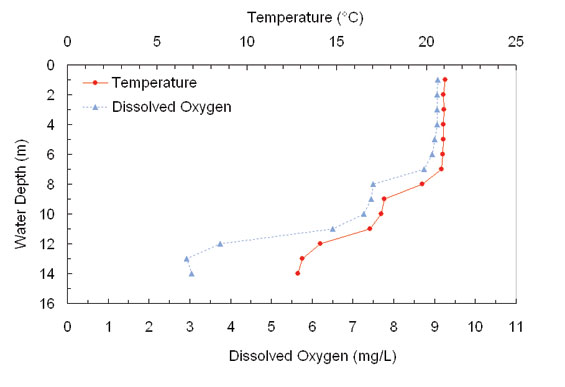
Dissolved oxygen in lakes, which is critical to sustain aquatic life, originates from the atmosphere and phytoplankton productivity, and is consumed by biological activity and decay. In addition, dissolved oxygen concentrations are strongly related to water temperature. Recent observations in Lake Winnipeg have indicated that there may be complex spatial and temporal variation in dissolved oxygen concentrations including the occurrence of oxygen-depleted conditions.
Dissolved oxygen concentrations in the surface waters of Lake Winnipeg from 1999 to 2007 were slightly lower in the south basin compared to the north basin, with only very small differences between concentrations in surface and bottom waters. Approximately 2% of dissolved oxygen measurements in surface waters in both basins were below the Manitoba Water Quality Objective for the protection of aquatic life (5 mg/L), with up to 6% below the objective in bottom waters of the north basin, indicating the potential for detrimental effects on aquatic biota.
Although waters in Lake Winnipeg are thought to be well mixed, temperature stratification from top to bottom has been observed on occasion in the north basin. Declines in water temperatures at the bottom of the lake can result in reduced availability of dissolved oxygen, which may threaten the survival of biota and increase the release of nutrients from sediments in the lake. Low dissolved oxygen concentrations were measured in bottom waters associated with temperature stratification, or a thermocline, in the summers of 2003, 2005 and 2007, as well as below ice in the winter of 2006. It is likely that the thermocline was eroded in the summer by strong winds that mixed the water column. The spatial extent and duration of low oxygen zones in Lake Winnipeg are not known and are undergoing further investigation.

Suspended solids are mineral and organic materials derived from both within the lake and through its tributaries, from erosion, biological activity in the water, re-suspension of lake bottom materials, and to a lesser degree from atmospheric deposition. The mineral component of total suspended solids may carry adsorbed nutrients, and the biological component is itself composed largely of nutrients. Therefore, deposition and re-suspension of particles can affect nutrient storage and availability in the lake. In addition to impacting nutrients in lakes, suspended solids play a large role in limiting the transmission of light through the water column, thereby limiting biological productivity and affecting the types and abundance of biota in the lake. For example, cyanobacteria, which often form a large component of the algae biomass in Lake Winnipeg, thrive in waters high in suspended solids.
Suspended solid concentrations in Lake Winnipeg’s north basin were typically two to three times lower than those in the south basin from 1999 to 2007, averaging 5.2 mg/L for the north and 11.8 mg/L for the south. Light penetrated to greater depths in the clearer waters of the large, deep north basin. Secchi depth in the north basin was on average 0.8 m greater than that in the south basin. Higher total suspended solid concentrations late in the open water season in the north basin of Lake Winnipeg are generally the consequence of phytoplankton growth over the summer. Higher sediment concentrations in the south basin can be attributed to the high sediment loads carried by the Red River and to the greater susceptibility of the bottom sediments to wind-driven re-suspension in shallower waters. Wind-driven re-suspension of the sediments in the lake, thought to be a significant process in Lake Winnipeg’s shallow waters, has implications for biological productivity, as well as for the release of nutrients from the lake bottom into the water column.
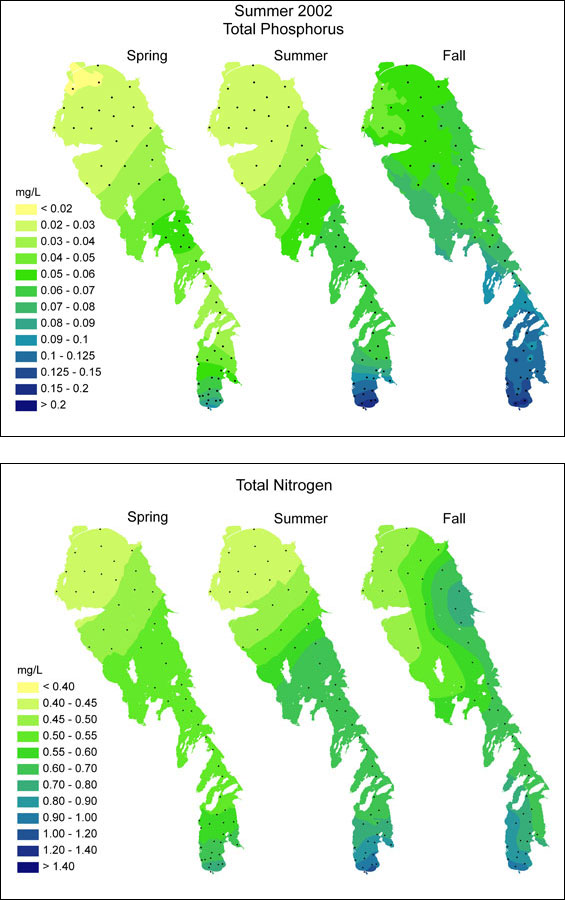
Phosphorus and nitrogen are the two major nutrients required for plant growth and occur naturally in soils, rocks and vegetation. Accelerated phosphorous and nitrogen loading from anthropogenic sources can lead to nuisance algal blooms, and is a problem facing many countries worldwide. Historical records indicate more pronounced rates of phosphorous and nitrogen deposition in Lake Winnipeg in the second half of the 20th century, attributable to anthropogenic inputs. Recent studies on the lake have shown that phosphorous concentrations in lake bottom sediments in the late 1990s and the 2000s were elevated and that a portion of these nutrients is available for biological activity such as algae growth.
Recent water quality monitoring has indicated that Lake Winnipeg is generally classified as eutrophic or hypereutrophic, meaning that the lake is highly enriched with plant nutrients. From 1999 to 2007, the average total phosphorous concentration in Lake Winnipeg was almost three times higher in the south basin and narrows (0.113 mg/L) compared to the north basin (0.044 mg/L). Total nitrogen was also highest in the south basin (0.869 mg/L) compared to the north basin (0.653 mg/L). Higher nutrient concentrations generally occurred at the very south end of the lake and declined moving northward. Elevated nutrient concentrations at the southern end of Lake Winnipeg were likely associated with the nutrient-rich inflow of the Red River. Total phosphorus was generally greatest in the fall and may be partly related to the internal nutrient load from the lake.
Phosphorous concentrations did not appear to vary greatly in the north basin of Lake Winnipeg from 1999 to 2007. However, over the same time period, phosphorous concentrations in the south basin appeared to increase with higher concentrations observed in 2005 to 2007. Mean annual phosphorous concentration was highest in Lake Winnipeg in 2005 when flow, total phosphorous concentrations and phosphorous loading from tributaries were greatest (between 1994 and 2007). Total nitrogen concentrations in Lake Winnipeg were variable, with no apparent change or trends since 1999. Large inter-annual variation in total nitrogen concentrations may be partly related to inter-annual variability in the biomass of nitrogen-fixing cyanobacteria. When compared to historical data collected during a lake-wide cruise in 1969, average phosphorous and nitrogen concentrations observed during the period from 1999 through 2007 were in the same range as in 1969. However, nutrient concentrations observed in 1969 were generally at the low end of the range observed in the recent decade, suggesting a possible increase between 1969 and the present. A paleolimnological study, a study of cores of lake bottom sediments deposited over centuries, is currently under way and is expected to provide additional information on historical water quality changes in Lake Winnipeg since the early 1800s.
The Red River is the largest source of total phosphorus and nitrogen to Lake Winnipeg, while the Winnipeg River contributed the second-largest load of phosphorus and nitrogen to the lake. On average, about 60% of the phosphorus and 54% of the nitrogen transported to Lake Winnipeg by tributaries and atmospheric deposition was retained in the lake. Phosphorous loads to Lake Winnipeg from the Red River were higher in high flow years and contributed as much as three quarters of the total phosphorous load to Lake Winnipeg. Rates of nitrogen and phosphorus export per hectare were also highest in the Red River and its tributaries compared to other major tributaries to Lake Winnipeg.
An understanding of both the sources and in-lake processing of phosphorus and nitrogen is required to better manage and adapt remediation strategies. A study has been undertaken to identify the various sources of phosphorus through the use of isotopes. Different sources of phosphorus with distinct “fingerprints” can potentially be identified, supporting future management decisions with regards to nutrient sources to the lake.
Source |
% Total Phosphorous Load |
% Total Nitrogen Load |
|---|---|---|
| Red River (at Selkirk) | 68 | 34 |
| Winnipeg River (at Pine Falls) | 15 | 25 |
| Saskatchewan River | 5 | 10 |
| Dauphin River | 1 | 4 |
| East Side rivers | 3 | 4 |
| Brokenhead, Fisher and Icelandic rivers | 1 | 1 |
| Atmospheric deposition | 7 | 11 |
| Nitrogen fixation | - | 11 |
Average annual percentage contribution of rivers, atmospheric deposition and fixation to the total phosphorous and nitrogen load in Lake Winnipeg from 1994 to 2007
Data source: Manitoba Water Stewardship
| Previous | Table of Contents | Next |