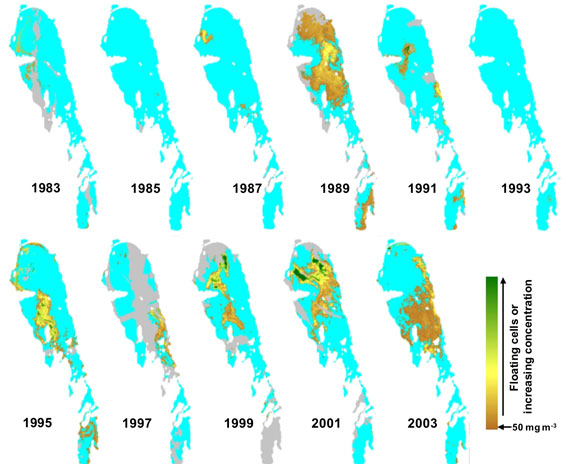
Satellite imagery of historic occurrence of algal cells (blooms) in Lake Winnipeg
Data source: AVHRR band optical data, G. McCullough
(click to view larger image)
| Previous | Table of Contents | Next |
Algal blooms have occurred historically in Lake Winnipeg. However, since the early 1990s, phytoplankton biomass and the intensity and frequency of algal blooms have increased, and phytoplankton composition has shifted to cyanobacteria dominance. Paleolimnological analysis of sediment cores from the south basin of Lake Winnipeg indicated that total algal abundance has increased 300 to 500% during the 20th century and that all algal groups have increased during the past 70 years. Phytoplankton surveys in 1969 revealed that in that year, average biomass was less than 2000 milligrams per cubic metre and comprised a diversity of taxonomic groups. Since 1999, there has been a progressive increase in mean biomass to over 4000 milligrams per cubic metre (2007), accompanied by a shift to a predominance of cyanobacteria.
Cyanobacteria blooms are of particular concern because of their potential to produce potent algal toxins that may pose health risks to humans and other animals. The algal toxin microcystin-LR is produced by certain species of cyanobacteria. Microcystin has been detected in nearshore and beach areas as well as in the offshore areas of Lake Winnipeg. From 1999 to 2007, concentrations of microcystin in the offshore areas of the lake generally remained very low and were well below the recreational and drinking water quality guidelines. However, in the nearshore and beach samples collected from Lake Winnipeg since 2000, elevated concentrations of microcystin were found to occur occasionally in the lake, potentially representing a health risk to recreational users.
Beaches in the south basin of Lake Winnipeg are monitored for the fecal indicator bacteria Esherichia coli (E. coli). Escherichia coli is a bacteria found in large numbers in all warm-blooded animals including humans, livestock, wildlife and birds. While E. coli itself does not generally cause illness, when it is present in large numbers, the risk of becoming ill from other organisms is elevated. The most common illnesses contracted by bathers are infections of the eyes, ears, nose and throat as well as stomach upsets. From 2004 to 2009 densities of E. coli bacteria at Lake Winnipeg beaches occasionally exceeded the Manitoba Water Quality Objective for recreation. However, densities usually returned to within acceptable limits within 24 hours. Beaches on the east side of Lake Winnipeg tended to have fewer occurrences of E. coli densities over the objective. Results of extensive sampling indicated that E. coli in beach sand is transferred to inshore bathing water when lake levels rise during strong northerly wind events. Genetic analyses suggest that the largest known source of E. coli in beach sand is from shorebirds and geese.
Aquatic invasive species are non-native organisms that have been introduced by humans into areas outside of their natural ranges. Aquatic invasive species can out-compete native species for food and other resources and significantly affect ecosystem function, the economic value of ecosystems and human health. Five aquatic invasive species are known to occur in Lake Winnipeg. These are Common Carp, Rainbow Smelt, White Bass, the cladoceran Eusbomina coregoni and Asian tapeworm. Of potential future concern are zebra mussels, which have recently been found in the United States portion of the Red River watershed. The spiny water flea was identified downstream from Pointe du Bois Dam on the Winnipeg River in 2010 and has the potential to be transported into Lake Winnipeg within the next few years if it is not already present in the lake. Other potential threats to Lake Winnipeg include the rusty crayfish, Koi Herpes virus, black algae and quagga mussels. Although it is difficult to predict impacts on Lake Winnipeg, these species may potentially alter ecological relationships among native species, affect ecosystem health and function, the economic value of ecosystems, and human health.
Computer modelling predicts that air temperatures in the Lake Winnipeg area will increase significantly over the next century and that surface water temperatures will increase accordingly. A 2.0ºC increase in mid-summer water temperatures could negatively impact as many as 12 fish species common to Lake Winnipeg including Lake Sturgeon, Lake Trout and Burbot. Warm-water species such as Walleye, Yellow Perch and White Bass would be expected to benefit. In addition, earlier spring melt and later freeze-up would lengthen the duration of the open water season, hence potentially increasing biological productivity and nutrient processing in the lake, and affecting the availability of water as evaporation losses change.
| Previous | Table of Contents | Next |