Click to enlarge
| Planning phase completed | June 2007 | Report sent for management response | September 2007 | Management response received | October 2007 | Report completed | December 2007 | Report recommended by the External Audit Advisory Committee | January 2008 | Approved by the Deputy Minister | February 2008 |
Prepared by Audit and Evaluation Branch
The Audit and Evaluation Project Team, including Simon Cloutier and led by Claudette Harrison under the direction of Jean Leclerc, would like to thank those individuals who contributed to this project and in particular all departmental interviewees who provided insights and comments crucial to this audit.
Original signed by:
Stephen McClellan
Chief Audit Executive
This audit was approved as part of the departmental Audit and Evaluation Plan 2006-07 to 2008-09.
On February 25, 2004, the Government of Canada announced the mandatory publication of information concerning the reclassification of occupied positions in the Public Service of Canada. Reporting requirements started in October 2004. The rules and principles governing the reclassification of occupied positions are outlined in the Public Service Human Resources Management Agency of Canada1 Guidelines on Reclassification and Guidelines on the Evaluation Process. The reclassification of a position occurs when the evaluation of its work description results in a change to either its occupational group or its level, or both, due to a significant change in the work assigned to the position.
The objectives of this audit were to determine whether the department is in compliance with the proactive disclosure policy and guidelines pertaining to reclassification of encumbered positions and to determine whether departmental controls, procedures, practices, and systems adequately capture all the necessary information, thus facilitating timely and accurate reporting.
The audit covered the position reclassifications processed between April 1, 2006, and March 31, 2007. A comparison of the reclassification data in the Human Resources database and the reports published on the Internet (April-June 2006, July-September 2006, October-December 2006, and January-March 2007) was carried out as part of the audit.
Since all position reclassifications must be entered into the Human Resources Management Information System in order to be processed, we expected a compliance rate of close to 100% for proactive disclosure. However, Environment Canada does not have effective tools for retrieving all the necessary information from its Human Resources database. As a result, 35 transactions out of 179, or 20%, were not disclosed in fiscal year 2006-07.
Interviews with regional classification officers indicated there was a lack of consistency among regions as to the source(s) of data and the procedures for reporting to the Labour Relations, Classification and Compensation Division on the reclassifications processed during a given quarter.
The controls for ensuring completeness of information being disclosed were found to be weak in most regions and in the Labour Relations, Classification and Compensation Division. Many transactions were omitted from the information disclosed to the public because the Human Resources Management Information System or Excel reports generated in the regions are unreliable.
The procedures for entering classification data into the Human Resources Management Information System and ensuring the integrity of the data need to be standardized across all regions so that the accuracy and completeness of reports generated by the reporting tool can be increased. A standardized report for each region could then be prepared by the Labour Relations, Classification and Compensation Division and sent to the regions for validation.
The Assistant Deputy Minister, Human Resources Branch, should:
The Human Resources Branch has modified and adjusted the departmental Human Resources Management Information System Procedures in order to facilitate the capture of reclassification data. Regional directors of human resources are now held accountable for reporting all reclassifications in the departmental Human Resources Management Information System, which will be the only source of official data to be disclosed on the Internet. In fiscal 08-09 a Classification Performance Measurement and Monitoring framework will be developed and implemented and it will include the monitoring of reclassifications.
A data integrity consultant has been hired who will develop a data integrity plan by June 08 and assist in the implementation of this plan. This will be an interim measure that will contribute to the integrity of data in the new EC PeopleSoft environment which is expected to be implemented in June 09.
All reclassifications have been accounted for and have been made public.
As part of the Government of Canada’s initiatives to increase transparency, the government announced new policies on proactive disclosure of certain types of expenses or management actions:
Consequently, each department must publish this information on a quarterly basis on its Website. However, information that would normally be withheld under the Access to Information Act or the Privacy Act cannot be publicly disclosed.
The rules and principles governing the reclassification of occupied positions are outlined in the Public Service Human Resources Management Agency of Canada2 Guidelines on Reclassification and Guidelines on the Evaluation Process. The reclassification of a position occurs, as stated in the Guidelines on Reclassification, when the evaluation of its work description results in a change to either its occupational group or its level, or both, due to a significant change in the work assigned to the position. A reclassification may be upward, if the work becomes more demanding, or downward, if the work becomes less demanding. A detailed description of the reclassification process at Environment Canada may be found in Annex 1.
The objectives of this audit were to:
The audit covers the position reclassifications processed between April 1, 2006, and March 31, 2007, posted online under http://www.ec.gc.ca/reclassifications/ReclassBD_e.html.
The audit consisted of research and review of basic documentation, including policies, guidelines, and other relevant documents from the Treasury Board Secretariat and the Public Service Human Resources Management Agency of Canada. Interviews were conducted with Environment Canada staff and management responsible for reclassification of positions as well as proactive disclosure reporting. Furthermore, a detailed description of the process and control mapping of both the reclassification and proactive disclosure reporting activities was done to identify whether the controls and practices are complete, accurate, and in compliance with central agencies’ policies. Finally, the human resources database, Human Resources Management Information System (which contains all reclassifications), and the published proactive disclosure reports for 2006-07 (April-June 2006, July-September 2006, October-December 2006, and January-March 2007) were compared and analysed.
The Human Resources Management Information System database includes all types of reclassification actions for existing positions. It is important to note that, under the disclosure policy and guidelines, the only type of reclassification that needs to be disclosed is the reclassification of a current position. The classification of a new position, administrative actions, corrections to erroneous data, or the deletion of a position are not disclosed.
A detailed analysis of a report generated by the Human Resources Management Information System reporting tool (Discoverer) of all reclassifications for the period under review was conducted to identify possible cases of non-disclosure or omissions or errors in the reclassifications disclosed.
A second analysis was done of the reclassifications that were disclosed but were not included in the Human Resources Management Information System report. The purpose of this analysis was to verify whether all reclassifications posted could be found in the Human Resources Management Information System.
Results of the audit testing indicate that at least 35 transactions out of 179, or 20%, were not disclosed. Due to limitations imposed by the Human Resources Management Information System reporting tool, a complete listing of all reclassifications during the year could not be obtained. Consequently, the audit could not draw any conclusions on the exact number of reclassifications missed. The Human Resources database will be discussed in greater detail in the next two sections. The audit found only two minor administrative errors among the 144 reclassifications posted on the Internet.
In order to allow an analysis of the transactions disclosed on the Internet, a report of reclassifications was generated from the Human Resources Management Information System for the period under review. The number of transactions in the database should be the same as the number of transactions posted on the Internet. However, the Human Resources database report contained only 107 reclassifications compared with 144 reclassifications on the Internet.
Further analysis and discussions with a Human Resources Management Information System business analyst led us to conclude that the Human Resources Management Information System report we had generated was the appropriate report and that the missing transactions were mostly the result of subsequent transactions not having been recorded properly in the log. For example, a position may be reclassified and the position number for that position may later change. Unless the registry is updated, only the most recent action appears in the report generated by Discoverer. In our example, the report from Discoverer would list only the change in the position number and would ignore the previous reclassification action.
The information disclosed was verified against the official document for the reclassification of a position (the Treasury Board 330 form in the Human Resources Management Information System). Certain fields from the information available on the Internet, such as the position title, former and new classification, and reason for reclassification, were compared with the data in the Human Resources Management Information System. The audit found very few errors in the data that had been posted on the Internet.
The following graph illustrates the reclassifications disclosed and the reclassifications not disclosed in each region, based on our analysis. The upper portion of the bar shows the number of transactions disclosed, whereas the lower portion of each bar, where applicable, shows the number of transactions that were not disclosed but should have been.
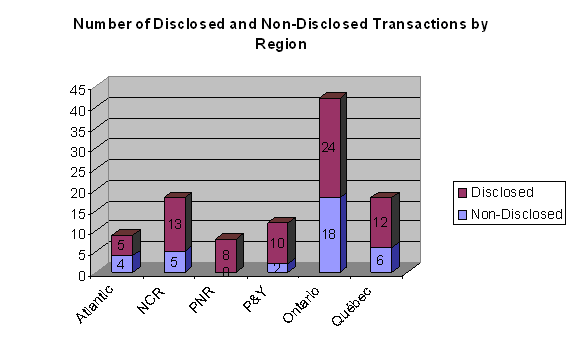
Please note that the graph was produced according to the region where the position is physically located. In some situations, for example, the meteorologist training program, reclassifications are managed by one region on behalf of other regions.
The following table illustrates the disclosure results for reclassifications at the departmental level. It shows that at least 20% of the transactions were not disclosed.
Disclosed and Non-Disclosed Transactions |
||
# of transactions |
% of transactions |
|
| Disclosed | 144 |
80 |
| Non-disclosed | 35 |
20 |
| Total transactions to be disclosed | 179 |
100 |
The results should be substantially improved to ensure that all reclassifications are disclosed.
The audit found that there was a lack of consistency among regions in terms of the source(s) of data and the procedures for reporting to the Labour Relations, Classification and Compensation Division on the reclassifications processed during a given quarter.
The audit also found the controls to ensure that complete information is being disclosed were weak in most regions and in the Labour Relations, Classification and Compensation Division.
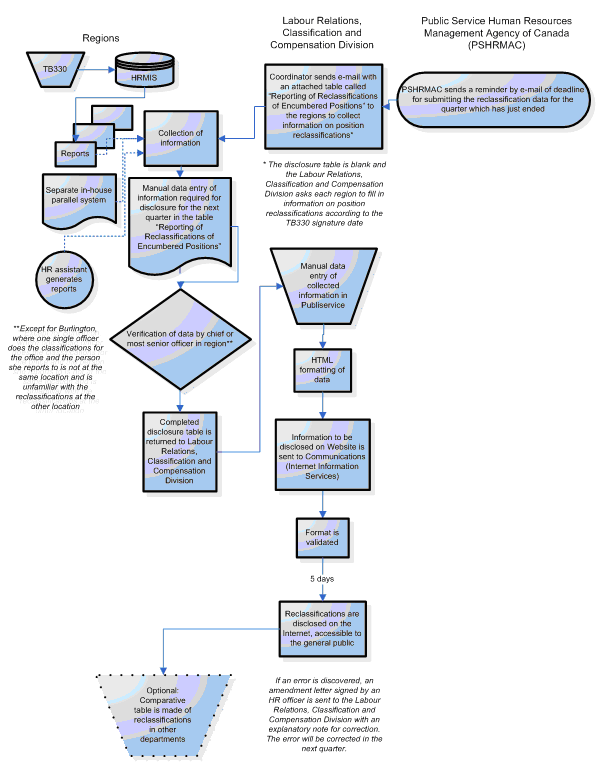
A detailed description and flowchart of the disclosure process for reclassifications at Environment Canada may be found in annexes 2 and 3.
Many transactions were omitted because the Human Resources Management Information System or Excel reports in the regions are unreliable. The majority of these reports were generated by human resources assistants and were subsequently verified by the chiefs of classification. Classification managers stated they relied primarily on memory when verifying the reports. The results show one in five reclassification transactions was omitted. More reliable systems are therefore required to ensure compliance. When asked why the transactions had not been disclosed, the managers indicated that the transactions were inadvertently missed or were not in the regional reports generated by either the Human Resources Management Information System or parallel systems.
A good practice exists in the Prairie and Northern Region, where the report is produced by a Human Resources Management Information System IT coordinator. This person maintains the system to ensure the integrity of the data. There were no omissions or errors in the reporting from this region.
The procedures for entering classification data into the Human Resources Management Information System and ensuring the integrity of the data need to be standardized across all regions so that the accuracy and completeness of reports generated by the reporting tool can be increased. A standardized report for each region could then be prepared by the Labour Relations, Classification and Compensation Division and sent to the regions for validation.
The Assistant Deputy Minister, Human Resources Branch, should:
The Human Resources Branch has modified and adjusted the departmental Human Resources Management Information System Procedures in order to facilitate the capture of reclassification data. Regional directors of human resources are now held accountable for reporting all reclassifications in the departmental Human Resources Management Information System, which will be the only source of official data to be disclosed on the Internet. In fiscal 08–09 a Classification Performance Measurement and Monitoring framework will be developed and implemented and it will include the monitoring of reclassifications.
A data integrity consultant has been hired who will develop a data integrity plan by June 08 and assist in the implementation of this plan. This will be an interim measure that will contribute to the integrity of data in the new EC PeopleSoft environment which is expected to be implemented in June 09.
All reclassifications have been accounted for and have been made public.
Environment Canada is not fully in compliance with the proactive disclosure policy for reporting reclassifications of encumbered positions and does not have effective tools in place to provide all the necessary information. As a result, 35 transactions out of 179, or 20%, were not disclosed during 2006-07.
Improvements can be made through standardized reporting mechanisms, increased controls put in place by the Labour Relations, Classification and Compensation Division, and clear procedures for data entry and maintenance in the Human Resources Management Information System.
In our professional judgement, sufficient and appropriate audit procedures have been conducted and evidence gathered to support the accuracy of the conclusions reached and contained in this report. The conclusions were based on a comparison of the situations as they existed at the time against the audit criteria.
The process begins with a request from a manager to reclassify a position. The delegated manager must provide the following documents to the Classification unit in National Human Resources Services: a signed Personnel Action Request Form, a signed job description (signed by the manager and if possible by the incumbent), and a signed and dated organization chart. The request is then logged in the Human Resources Management Information System.
The classification officer pulls the position file and conducts a relativity study of the current position (compares it with other positions within Environment Canada and in the government). The position is then tentatively reviewed/evaluated against the Treasury Board classification standards.
If the tentative review indicates a reclassification may be in order, the incumbent of the position will be contacted and an on-site review will be conducted (in person or by telephone interview). The on-site review is used to validate the work description (ensure the work assigned is being performed) and to better understand the duties of the position. This information is later used in the evaluation of the position.
If coincidence is found in the on-site review (the assigned duties are being performed), a classification committee is formed, ideally of three members trained in classification and familiar with the duties of the position and the organization in which the position sits. As there is a shortage of managers at Environment Canada trained in classification, Human Resources will occasionally invite managers or classification officers from other government departments to form the committee. Interdepartmental committees are often encouraged by Treasury Board in contentious situations and/or situations where there may be a broad impact.
The committee evaluates the job based on the Treasury Board Classification Standards and renders a classification recommendation.
Once a classification decision has been made, the last step is the signature and approval of the Treasury Board 330 form by a delegated individual in Human Resources. The 330 form is the official document for the classification of positions. It is generated in the Human Resources Management Information System and is signed by the classification officer and the responsible manager.
A letter is sent to the incumbent of the position and to the manager to inform them of the classification decision and results. It has to be signed by both the employee and the manager and returned to Human Resources. The 330 form and all relevant documentation are placed in the position file.
When the signed letter is returned to Human Resources, the Human Resources Management Information System is updated and the file is closed (completed date).
A copy of the letter to the employee is provided to the Staffing unit in National Human Resources Services for appropriate action.
The process starts when the Public Service Human Resources Management Agency of Canada3 sends a reminder by e-mail to the corporate coordinator in Environment Canada of the deadline for submitting the data pertaining to the reclassification of positions.
The corporate coordinator sends an e-mail to the regions with an attached blank table to be completed manually by each region. The table contains all fields to be disclosed. The instructions in the e-mail specify the requirement to include only those reclassifications for which the Treasury Board 330 form was signed in the quarter being reported.
Here is the process in the regions for retrieving information.
Information is entered manually in the template table, usually by an assistant or officer. The reclassification information in the table is verified by the chief/manager or most senior classification officer in the region. An exception is the Burlington office; in this case the information is entered by the classification officer and is sent to the Downsview office but is not verified by the chief.
Atlantic, Ontario, Pacific and Yukon, and Prairie and Northern: The most senior officers in these regions indicated that they rely on memory when verifying that all transactions have been included. Since there are a minimal number of transactions and they have worked extensively on the files, they assured us that they know what has been done.
National Capital Region: Custom reports in Discoverer are printed out and are compared with the number of transactions in the log. The log is the area in the Human Resources Management Information System where all the requested reclassifications are entered. This allows the Human Resources Management Information System report to be compared with the log to see if anything is missing. If yes, they investigate.
Quebec: The region uses a double entry system (the Human Resources Management Information System and an Excel spreadsheet). The region also has two special programs that result in frequent reclassifications. The first one is the meteorologist training program, with about 25 to 30 reclassifications per year. The second one is the Research Scientist classification (SE-RES) program. A committee evaluates the work of researchers and decides if they should be reclassified. There are about 5 or 6 reclassifications of this type per year.
When the table requested by the Labour Relations, Classification and Compensation Division is ready, the regions send it back to Labour Relations, Classification and Compensation. The information is then entered manually on the Publiservice Website: publiservice.psagency-agencefp.gc.ca/classification/Reclass/Reclass_e.asp. From then on, no modifications can be made to the information. When all data entries are completed and ready to be downloaded and sent to the Communications Branch, the material is converted to HTML on the Publiservice Website. The Labour Relations, Classification and Compensation Division then sends an e-mail to Internet Information Services in the Communications Branch (to let them know that the data have been downloaded onto HTML pages). Internet Information Services informs the Labour Relations, Classification and Compensation Division when they have updated the EC Disclosure of Position Reclassifications Web page (http://www.ec.gc.ca/reclassifications/ReclassBD_e.html). Finally, the Labour Relations, Classification and Compensation Division provides Internet Information Services with the due date on which all reclassifications must be posted on the government-wide Disclosure of Position Reclassifications Web page maintained by the Public Service Human Resources Management Agency of Canada4 at http://www.psagency-agencefp.gc.ca/Classification/Reclass/ReclassAlpha_e.asp. Also, the Labour Relations, Classification and Compensation Division prepares a note for Lynette Cox, Assistant Deputy Minister, Human Resources, to send to Executive Management Committee informing the committee of reclassifications to be published.
Internet Information Services then ensures all the information is available to the public.
If there is a mistake in the information that has been posted, it is corrected in the report for the next quarter. To correct the information in the Human Resources Management Information System, an amendment letter, signed by staffing, is sent to the Labour Relations, Classification and Compensation Division asking that the appropriate changes be made.
1Public Service Human Resources Management Agency of Canada was the name of the central agency at the time of the audit; it is currently called the Canada Public Service Agency.
Return2Public Service Human Resources Management Agency of Canada was the name of the central agency at the time of the audit; it is currently called the Canada Public Service Agency.
Return3Now the Canada Public Service Agency.
Return4Now the Canada Public Service Agency.
Return